What Is a Local Authority Search?
A local authority search checks the council's records for planning, building control, roads and charges that affect a property. What it covers, the two types, and what happens next.
Key takeaways
- A local authority search checks the council's records for anything that affects a property: planning decisions, building regulations, roads, charges and notices.
- It has two parts: a search of the local land charges register, and answers to the standard CON29 enquiries about the property.
- There are two types: the council's own official search, and a regulated search compiled by an independent search agent from the same records.
- Your lender will expect one, and it is usually the search that takes longest to come back.
- It covers the property and the roads next to it, not the wider area, so other searches cover things like flood risk and drainage.
A local authority search is one of the first things your solicitor orders when you buy a property. It asks the council what its records say about the property: whether the work done on it had planning permission and building regulations approval, whether the road outside is maintained by the council, and whether there are charges, restrictions or plans that could affect it.
This guide explains what the search covers, the two types you can order, how long it takes and what happens when it flags something.
What a local authority search covers
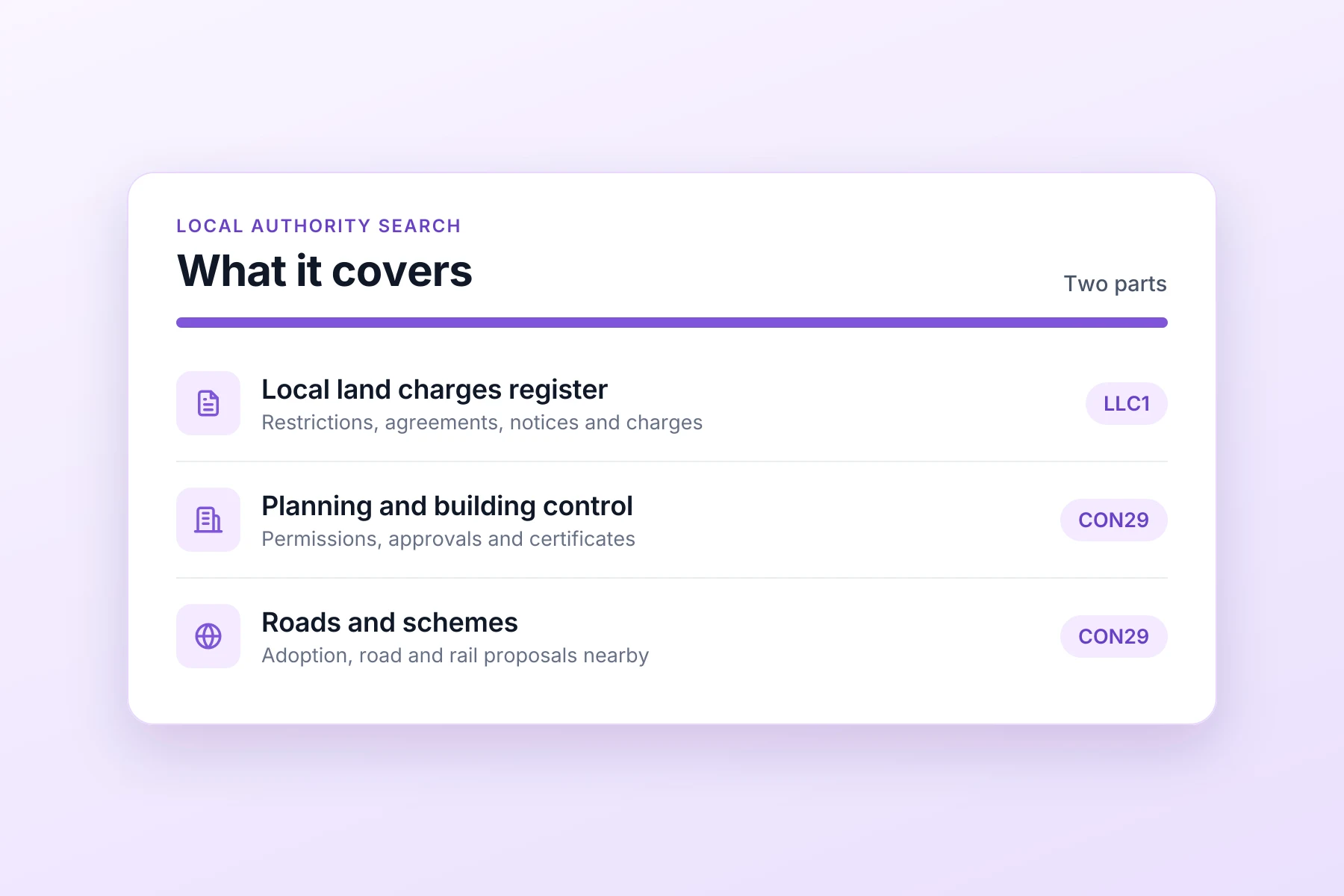
The search has two parts.
- A search of the local land charges register. The register records restrictions and charges on land, such as tree preservation orders, conservation areas, listed building status, planning agreements, enforcement notices and some financial charges. The council's official certificate of this search is called the LLC1.
- Answers to the CON29 enquiries. These are standard questions about the property that the register does not cover: planning and building regulations history, whether the roads are adopted, road and rail schemes nearby, notices the council has served, and more.
Your solicitor can also add optional enquiries, known as CON29O, for things such as common land, pipelines, or houses in multiple occupation, where the property or area makes them relevant.
What it can tell you
Typical findings include:
- Planning history. Permissions, refusals and conditions on the property, which your solicitor checks against what has actually been built.
- Building regulations. Approvals and completion certificates for building work, such as an extension or a loft conversion.
- Roads. Whether the road is adopted, meaning the council maintains it, or private, in which case owners may share the cost of repairs.
- Restrictions. Conservation areas, listed buildings and tree preservation orders, which limit what you can change.
- Notices and proposals. Enforcement notices, compulsory purchase, and road or rail schemes near enough to affect the property.
The two types of local authority search
- An official search is compiled by the council itself: the LLC1 certificate and the council's replies to the CON29.
- A regulated search is compiled by an independent search agent, who inspects the same council records and answers the same enquiries in a report, under the Search Code and backed by insurance.
Both are accepted by most lenders. A regulated search is usually quicker, because it does not wait in the council's queue for replies. See regulated or official: which local search should you order?
How long it takes
It depends on the council. Some return a search within a few days; others take several weeks, and the time can change from month to month. It is usually the slowest of the searches. See how long do searches take when buying a house?
What it does not cover
A local authority search reports on the property and the roads that serve it. Other risks need other searches:
- Flood risk, contaminated land and ground stability are covered by an environmental search. See what does an environmental search show?
- Mains water and sewers are covered by a drainage and water search.
- Coal mining and other local risks need their own searches where the area calls for them.
- Planning applications on neighbouring land are not usually included, so your solicitor may check the council's planning register as well.
What happens if it flags something
A flagged entry is not necessarily a problem. Your solicitor reads the search, raises enquiries with the seller's solicitor about anything that needs explaining, and advises you on what it means. That might mean asking for a missing certificate, arranging indemnity insurance, or in rarer cases renegotiating or walking away. See missing building regulations certificate? What buyers can do.
How Casera can help
Casera provides regulated and official local authority searches to solicitors and conveyancers, for every council in England and Wales. We aim to return a search within a day of the council's information arriving, in a report that flags the entries that matter. See property searches.
If your purchase is waiting on a search, tell us what is outstanding and who your solicitor is, and our search team will get in touch with them.
Frequently asked questions
What does a local authority search show?
Planning permissions and refusals, building regulations approvals, whether the road is adopted, local land charges such as tree preservation orders and conservation areas, enforcement notices, and proposals such as new road schemes that could affect the property.
Do I need a local authority search?
If you are buying with a mortgage, yes: your lender will expect one. Cash buyers can choose not to, but it is the main way to find out about planning and council issues before you commit.
Who orders the local authority search?
Your solicitor or conveyancer, usually shortly after your offer is accepted and you have paid for the searches.
What is the difference between an LLC1 and a CON29?
The LLC1 is the official search of the local land charges register: restrictions and charges registered against the property. The CON29 is the set of standard enquiries about the property, such as planning history, roads and notices. An official search includes both.
Does a local authority search cover neighbouring properties?
Mostly not. It reports on the property itself and the roads that serve it, with some enquiries about schemes nearby. Planning applications on neighbouring land usually need checking separately.