What Does an Environmental Search Show?
An environmental search reports on contaminated land, flood risk, ground stability, radon and more. What each section means, what a pass or further action result means, and what to do next.
Key takeaways
- An environmental search is a desktop report on the risks around a property: contaminated land, flooding, ground stability, radon, and energy and infrastructure projects.
- It is compiled from historical maps and official datasets, not a site visit, and many are back within minutes.
- Most reports give an overall result: a pass, or a further action flag with recommendations on what to check next.
- A further action result is not a reason to stop. It tells you which questions to raise, and often points to a more detailed report.
- The Law Society's practice notes on contaminated land, flood risk and climate change all expect conveyancers to consider these risks.
An environmental search is the report that tells you what is in and under the ground around a property, and what the weather and the climate could do to it. For a conveyancer, it answers questions a local authority search does not: was this site once a factory, is it in a flood zone, is the ground stable?
This guide explains what an environmental search covers, how to read the result, and what to do when it flags something.
What an environmental search is
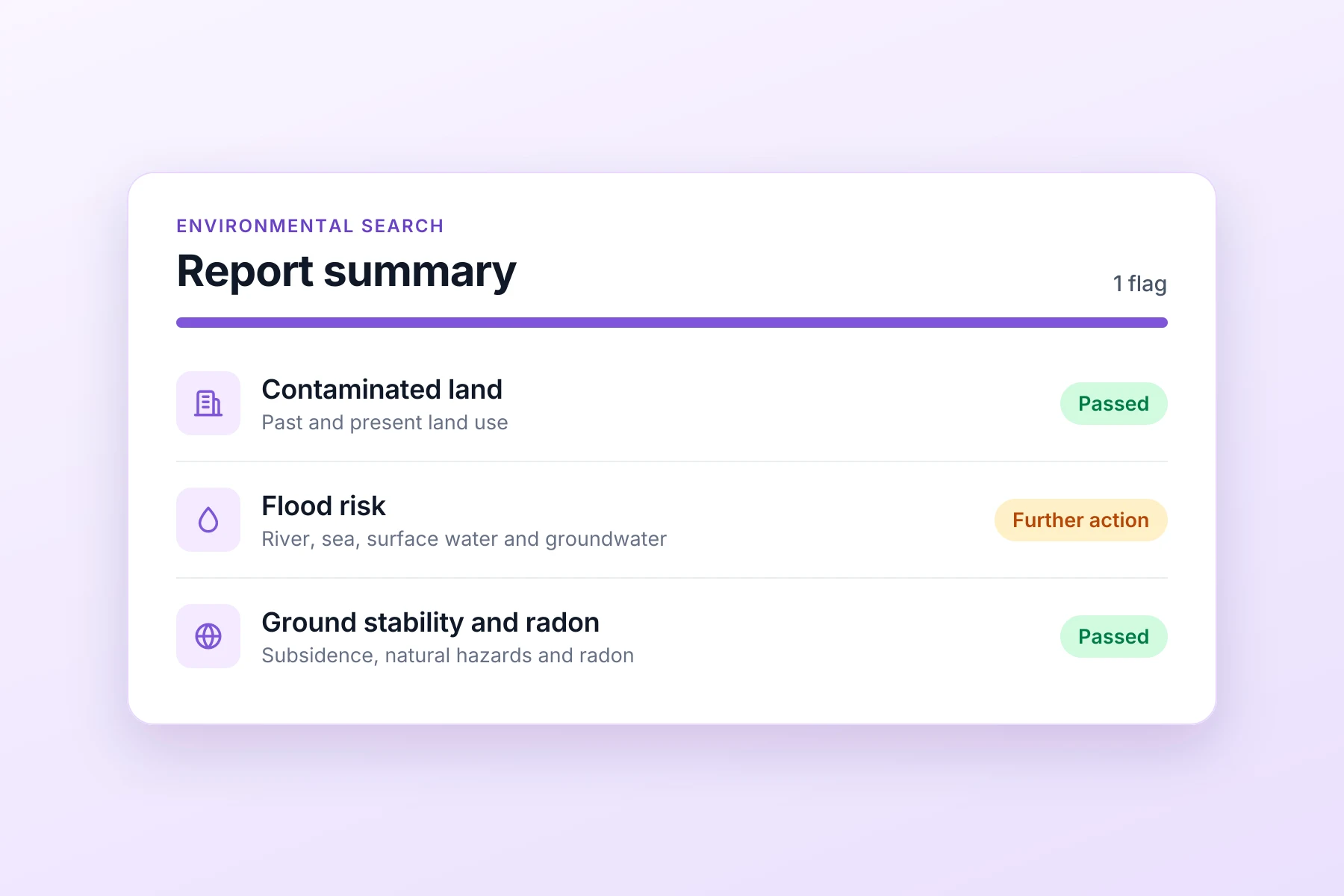
An environmental search is a desktop report: it is compiled from historical maps, official datasets and the provider's own models, not a site visit. Specialist providers produce them, and many residential reports are back within minutes. Most give an overall result for the property, with a section for each risk.
What it covers
- Contaminated land. Past and present land use around the property, such as factories, landfill or petrol stations, and whether the land could be designated as contaminated land under Part 2A of the Environmental Protection Act 1990, which can make an owner liable for clean-up costs.
- Flood risk. The risk from rivers, the sea, surface water and groundwater, and sometimes past flood events and insurance availability.
- Ground stability. Subsidence, natural ground hazards such as shrinking clay, and in some reports mining.
- Radon. Whether the property is in an area where radon gas is more likely, which may call for testing or protective measures.
- Energy and infrastructure. Nearby wind and solar farms, power lines, oil and gas sites, and transport projects such as railways.
- Climate risk. Many reports now project how flood, heat and ground risks may change over the coming decades.
Reading the result
Most reports start with an overall result:
- Passed, or no further action. The provider's consultants consider the risks low enough not to need more work. You still report the findings to your client.
- Further action. A risk is worth looking into. The report explains why and recommends next steps.
A further action result is not a reason to stop. It tells you which questions to raise, and often points to a more detailed report, such as a full flood risk assessment.
What to do when it flags something
- Raise enquiries with the seller, for example about past flooding, flood defences or the history of the site.
- Order a more detailed report where the search recommends one, such as a flood report or a contaminated land assessment.
- Check insurance for flood risk, and whether the property is covered by Flood Re.
- Take specialist advice from an environmental consultant where the risk is significant.
- Report the findings to your client, and to the lender if its instructions require it.
What the professional guidance expects
The Law Society's practice notes on contaminated land, flood risk and climate change all expect conveyancers to consider these risks on residential purchases, and to advise clients on them. An environmental search on every purchase is the usual way to meet that, and lenders expect it.
How Casera can help
Casera provides environmental searches from Groundsure, Landmark and Martello, so your firm can choose the provider it prefers. They are ordered on the same case as the local authority and drainage and water searches, and many are back within minutes. See property searches.
Frequently asked questions
What does an environmental search cover?
Contaminated land, based on past and present land use; flood risk from rivers, the sea, surface water and groundwater; ground stability, such as subsidence and natural ground hazards; radon; and nearby energy and infrastructure projects. Many reports also include climate risk projections.
Is an environmental search mandatory?
Not by law, but lenders and the Law Society's practice notes expect conveyancers to consider environmental risk on every purchase, and an environmental search is the usual way to do it.
What does further action mean on an environmental search?
That the provider's consultants have found a risk worth looking into. The report explains why and recommends next steps, such as enquiries of the seller, a more detailed flood report, or advice from an environmental consultant.
How long does an environmental search take?
Usually within a few days, and many residential reports within minutes, because they are compiled from digital datasets.
Who provides environmental searches?
Specialist providers such as Groundsure, Landmark and Martello. Conveyancers can usually choose the provider they prefer when they order.