How to Check a Seller's Solicitor's Bank Details Before Completion
Bank details intercepted by email are the most expensive fraud in conveyancing. How to verify the seller's solicitor and their account before you send completion funds.
Key takeaways
- The most expensive fraud in conveyancing is completion money sent to a fraudster's account, after bank details are intercepted or faked by email.
- Verify the firm first: that it exists, is regulated and practises from the address you have, using a source you find yourself, not the email.
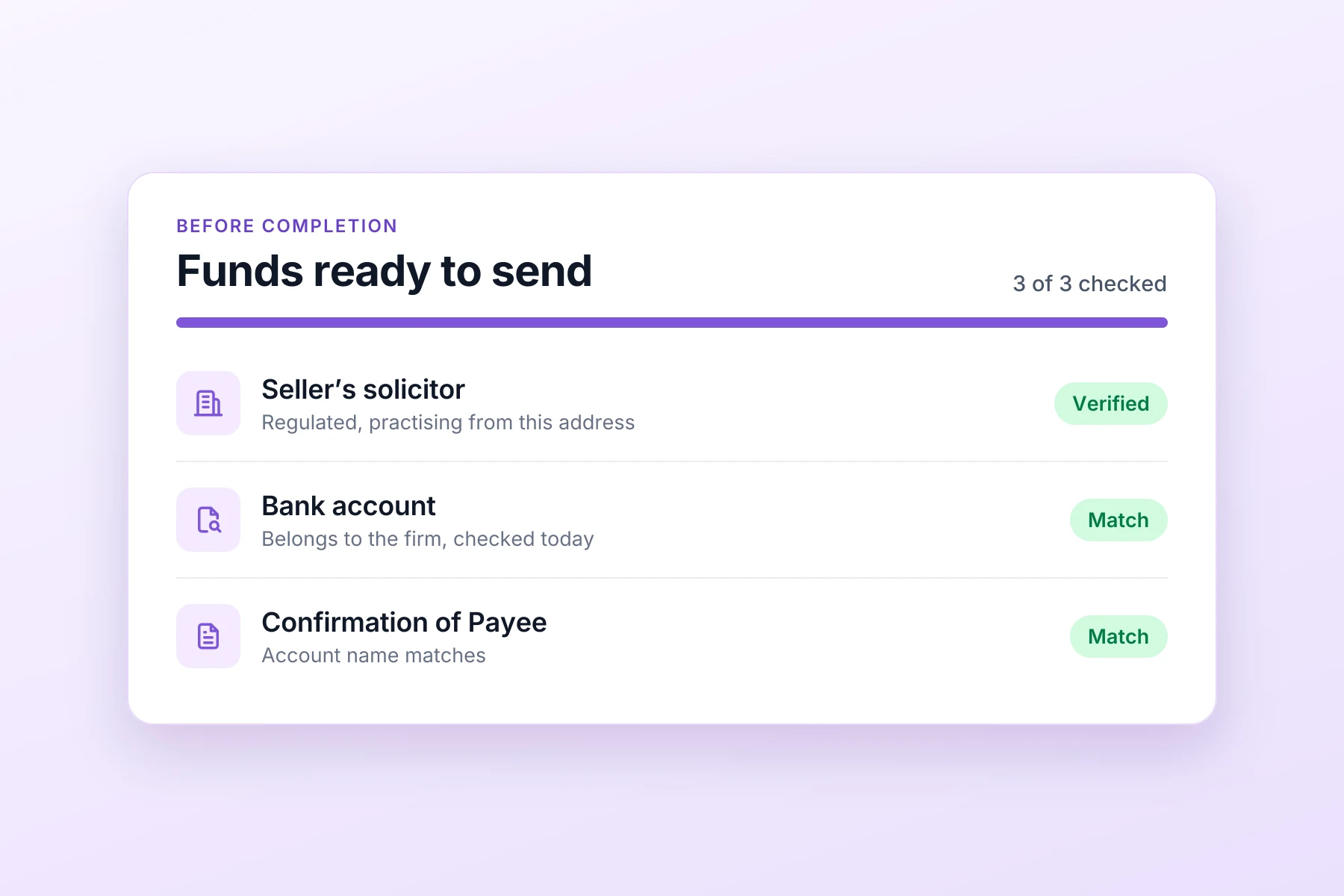
- Then verify the account: that the details belong to that firm, using an independent check and the payee's bank's Confirmation of Payee.
- Treat any change of bank details late in a transaction as fraud until proven otherwise, and confirm it by phone on a number you sourced independently.
- Check on the day you send the money, and record what you checked: a fraudster's best window is the afternoon of completion.
The most expensive mistake in conveyancing takes seconds: completion money sent to an account that belongs to a fraudster. It usually starts with an intercepted or spoofed email that changes the seller's solicitor's bank details, timed for the afternoon of completion, when funds move and everyone is in a hurry.
This guide sets out the checks to make before you send completion funds to the seller's solicitor, and what to record.
How the fraud works
Criminals gain access to an email account, at a firm, a client or an agent, or spoof one convincingly. They watch the transaction, and just before completion send new bank details, often with a plausible reason: the firm has changed banks, or the usual account is being audited. Funds sent to the new account are moved on within minutes and are rarely recovered.
Because it is often timed for a Friday, it is known as Friday afternoon fraud.
Step 1: verify the firm
Before you rely on anything the seller's solicitor sends you, confirm the firm:
- It exists and is regulated. Check the Solicitors Regulation Authority's register for a solicitors' firm, or the Council for Licensed Conveyancers' register for a licensed conveyancer.
- It practises from the address you have, and the person you are dealing with works there.
- There are no warnings. Regulators publish warnings about firms and people being impersonated.
Use sources you find yourself. A website address or phone number in an email can be part of the fraud.
Step 2: verify the bank account
Then confirm the account belongs to that firm:
- Get the details from the right place. Bank details normally come with the completion information in the transaction's standard forms, not in a stray email.
- Call the firm to confirm them, on a number you sourced independently, and speak to someone you know is handling the matter.
- Run an independent bank account verification check, which confirms the account details belong to the firm, rather than relying on what the firm told you.
- Use Confirmation of Payee when you set up the payment. It checks the account name matches, but not that the account belongs to the firm you mean to pay, so it is a final check, not the only one.
Step 3: treat changes as fraud until proven otherwise
Genuine firms rarely change their client account in the middle of a transaction. If the details change:
- Do not send funds to details given by email.
- Call the firm on the number you sourced independently, not one in the email.
- Verify the new account with the same checks as the original.
- Tell your client never to act on bank details sent by email either, and to call you before sending money.
Step 4: check on the day, and record it
Run the checks on the day you send the money: details that were correct last week can have changed since. Then record what you checked, when, and the result, so the file shows the due diligence was done before funds moved.
Protect your own side too
The same fraud targets your clients. Tell buyers at the start that your bank details will never change by email, and that they should call you on a number they already have before sending any money. See what proof of funds does a solicitor need? for a guide you can share with buyers about the rest of the money checks.
How Casera can help
Lawyer Checker, ordered through Casera, verifies a law firm's identity, practising address, regulatory membership and actual bank account details in one check, in seconds. A match result is indemnified up to £250,000 for funds sent on the day of the search, and every check is stored on your Casera case. If completion slips, you re-run it on the new day at no extra cost. See Lawyer Checker.
Frequently asked questions
How do I verify a solicitor's bank details?
Confirm the firm is real and regulated using the regulator's register, call it on a number you found yourself to confirm the details, run an independent bank account verification check, and use Confirmation of Payee when you set up the payment.
What is Friday afternoon fraud?
A fraud in which criminals intercept emails between a firm and its client or another firm, then send fake bank details just before completion, often on a Friday afternoon when funds move and people are rushing.
Is Confirmation of Payee enough?
It is a useful check that the account name matches, but it does not tell you whether that account belongs to the firm you think you are paying. Use it alongside a check of the firm and an independent bank account verification.
What should I do if the bank details change?
Stop. Do not send funds to new details given by email. Call the firm on a number you sourced independently, speak to someone you know, and verify the new account before anything moves.
When should I run the checks?
On the day you send the money. Details that were correct last week can have been changed since.