
What Proof of Funds Does a Solicitor Need?
Why your solicitor asks where your deposit came from, the evidence they usually need for savings, a sale or a gifted deposit, and how to get it to them faster.
Key takeaways
- Anti-money laundering rules require your solicitor to check where the money for your purchase comes from, not just that you have it.
- For savings, expect to show bank statements that show the money building up. For a sale, the completion statement. For an inheritance, the estate accounts.
- A gifted deposit needs a signed declaration from the person giving it, their ID, and evidence of where their money came from.
- How far back the statements go depends on your solicitor's own policy, so ask for their checklist at the start.
- Some solicitors check source of funds through Open Banking: you approve access in your banking app instead of downloading and sending statements.
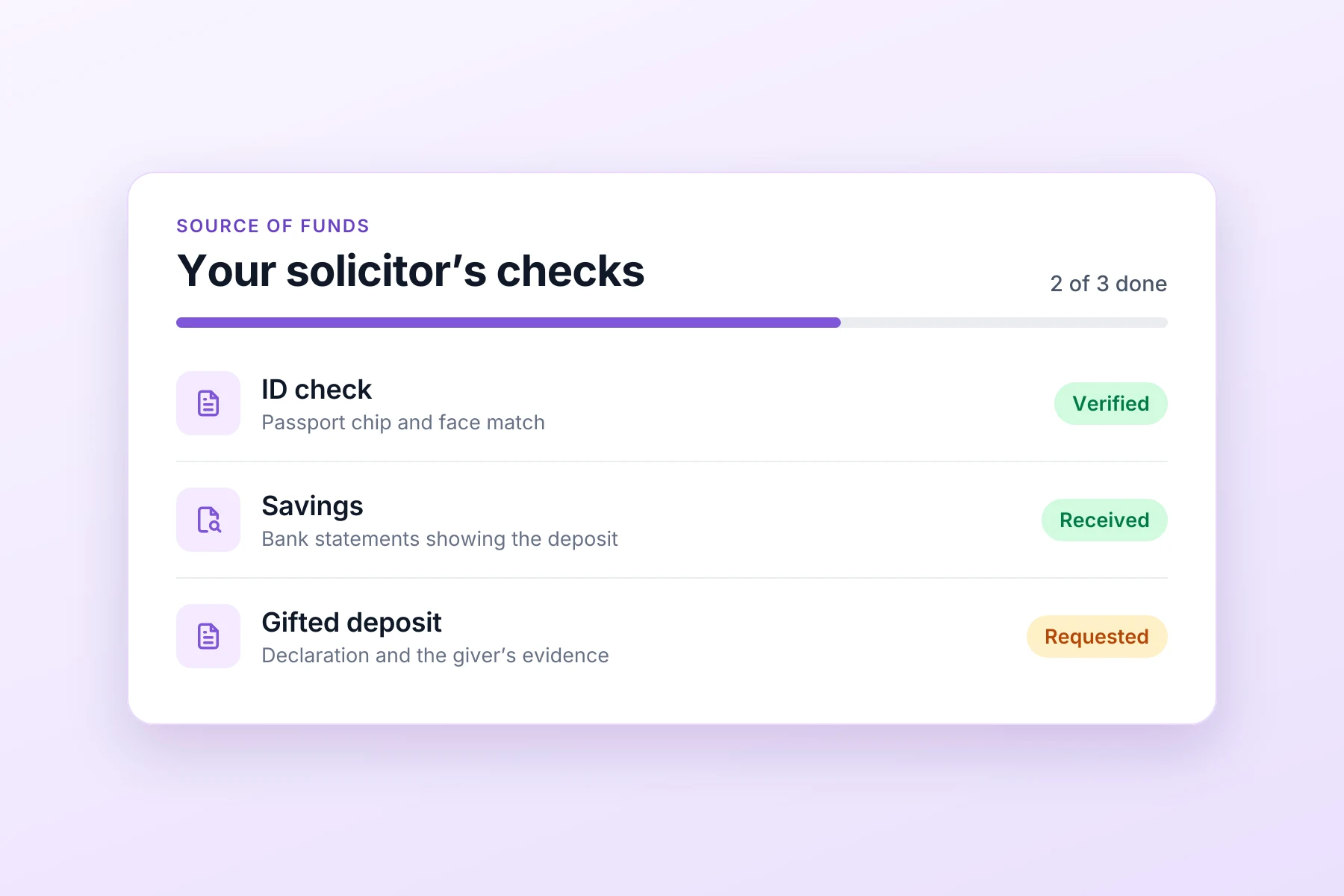
Few things surprise buyers more than the questions their solicitor asks about money. You have the deposit in the bank, so why do they need months of statements and paperwork from your parents? The answer is the anti-money laundering rules, and knowing what they need saves days of back and forth.
This guide explains why solicitors check source of funds, the evidence they usually ask for, what a gifted deposit needs, and how to get it to them faster.
Why solicitors check where your money comes from
Under the Money Laundering Regulations 2017, conveyancers have to check who their client is and where the money for a purchase comes from, before they act. It is not a judgement on you: property is a common target for money laundering, and the rules apply to every buyer.
So your solicitor needs to see two things: that you have the money, and how you came to have it. The second is where most of the questions come from.
What evidence solicitors usually ask for
It depends on where the money comes from. Typical evidence:
- Savings: bank or savings statements showing the money building up over time. Large or unusual payments in will need an explanation.
- A sale of another property: the completion statement from that sale.
- An inheritance: the estate accounts, or a letter from the solicitor who dealt with the estate.
- Investments: statements showing the sale of shares or funds and the money paid to you.
- A mortgage: your mortgage offer covers the borrowed part; the rest still needs evidence.
How far back statements need to go depends on your solicitor's own policy. Ask for their checklist at the start, so you send everything once.
Gifted deposits
A gift from family is one of the most common sources of a deposit, and it needs evidence from the person giving it as well as from you. Expect:
- A signed declaration that the money is a gift, not a loan, and that the giver will have no share in the property. Your lender will usually want one too.
- The giver's ID.
- Evidence of where the giver's money came from, such as their bank statements.
Some solicitors charge an extra fee for checking a gift, because they carry out checks on the giver as well. Your quote should say so.
How to get it to your solicitor faster
- Ask for the checklist on day one, and gather everything before you are chased.
- Send complete statements, not screenshots, covering the period your solicitor asks for.
- Explain anything unusual upfront, such as a large transfer from a family member.
- Get the giver involved early, so their ID and evidence are ready when yours is.
- Ask about Open Banking. Some firms check source of funds by asking you to approve access in your own banking app. They get a verified report built from your transactions and balances, and you do not download or send any statements.
Checking your ID
Solicitors also have to verify your identity. Many now use an app that reads the chip in your passport and matches your face to it, so you can complete the check on your phone in a few minutes, wherever you are.
How Casera can help
Casera provides AML, ID and Open Banking source of funds checks to solicitors and conveyancers. Your client approves access in their banking app, and the firm gets a verified report, with every result stored with a full audit trail. See AML and source of funds checks.
If your purchase is held up by proof of funds or ID checks, tell us who your solicitor is, and we will get in touch with them.
Frequently asked questions
What proof of funds do solicitors need?
Evidence of where the money for the purchase comes from: usually bank statements showing your savings building up, plus documents for any other source, such as the completion statement from a sale, estate accounts for an inheritance, or a gift declaration and the giver's evidence for a gifted deposit.
Why does my solicitor need to see my bank statements?
Anti-money laundering rules require them to understand where the money comes from before they can act. Statements show how the deposit built up, and any large or unusual payments they need to ask about.
What checks do solicitors do on a gifted deposit?
Usually a signed declaration that the money is a gift and not a loan, the giver's ID, and evidence of where the giver's money came from, such as their bank statements.
Do solicitors charge for gifted deposit checks?
Some do, because they carry out checks on the person giving the money as well. Your solicitor's quote should say so.
Can I do the ID check online?
Often, yes. Many firms use an app that reads the chip in your passport and matches your face to it, so you can complete the ID check on your phone.