Source of Funds Checks for Conveyancers: A Practical Guide
What the Money Laundering Regulations expect, how source of funds differs from source of wealth, the evidence to ask for by source, the red flags, and how to record it.
Key takeaways
- Source of funds is where the money for this transaction comes from. Source of wealth is how the client came to have their money overall. A purchase always needs the first; higher-risk clients need both.
- The Money Laundering Regulations 2017 require you to scrutinise transactions, including the source of funds where necessary, and to establish source of wealth and funds for politically exposed persons.
- Ask for evidence that matches the source: statements showing savings build up, a completion statement for a sale, estate accounts for an inheritance, and declarations and evidence from the giver of a gift.
- Red flags include cash, money from third parties or overseas, sudden large deposits, crypto, and a story that does not match the documents.
- Record what you asked for, what you received and why you were satisfied: an unexplained gap on the file is what supervisors find.
Source of funds checks are where a conveyancing file most often comes apart under review. The client's identity is verified, the risk assessment is done, and then the money arrives from somewhere the file never explains. This guide sets out what the regulations expect, the evidence to ask for, the red flags, and what a supervisor will want to see on the file.
Source of funds or source of wealth?
- Source of funds is where the money for this transaction comes from: savings, the sale of another property, a mortgage, a gift.
- Source of wealth is how the client came to have their money overall: employment, a business, an inheritance, investments.
Every purchase needs a source of funds check. Source of wealth is needed where the risk is higher, and always for politically exposed persons. The two often overlap: a large deposit from savings raises the question of how the savings were built up.
What the regulations require
The Money Laundering, Terrorist Financing and Transfer of Funds (Information on the Payer) Regulations 2017 require you to:
- Scrutinise transactions as part of ongoing monitoring, including the source of funds where necessary, so that they are consistent with what you know about the client.
- Apply enhanced due diligence where the risk is higher, which usually means more evidence and a closer look at source of wealth.
- Establish source of wealth and source of funds for politically exposed persons, their family and known close associates.
The Legal Sector Affinity Group's guidance sets out how this applies to legal practices. Your firm's own policy should set the evidence you expect at each level of risk.
The evidence to ask for
Match the evidence to the source:
- Savings: bank and savings statements showing the money building up over time, with explanations for large or unusual payments in.
- Sale of another property: the completion statement, or confirmation from the solicitor acting on the sale.
- Mortgage: the mortgage offer, for the borrowed part only.
- Inheritance: estate accounts, or confirmation from the solicitor or executor who dealt with the estate.
- Investments: statements showing the sale and the money paid to the client.
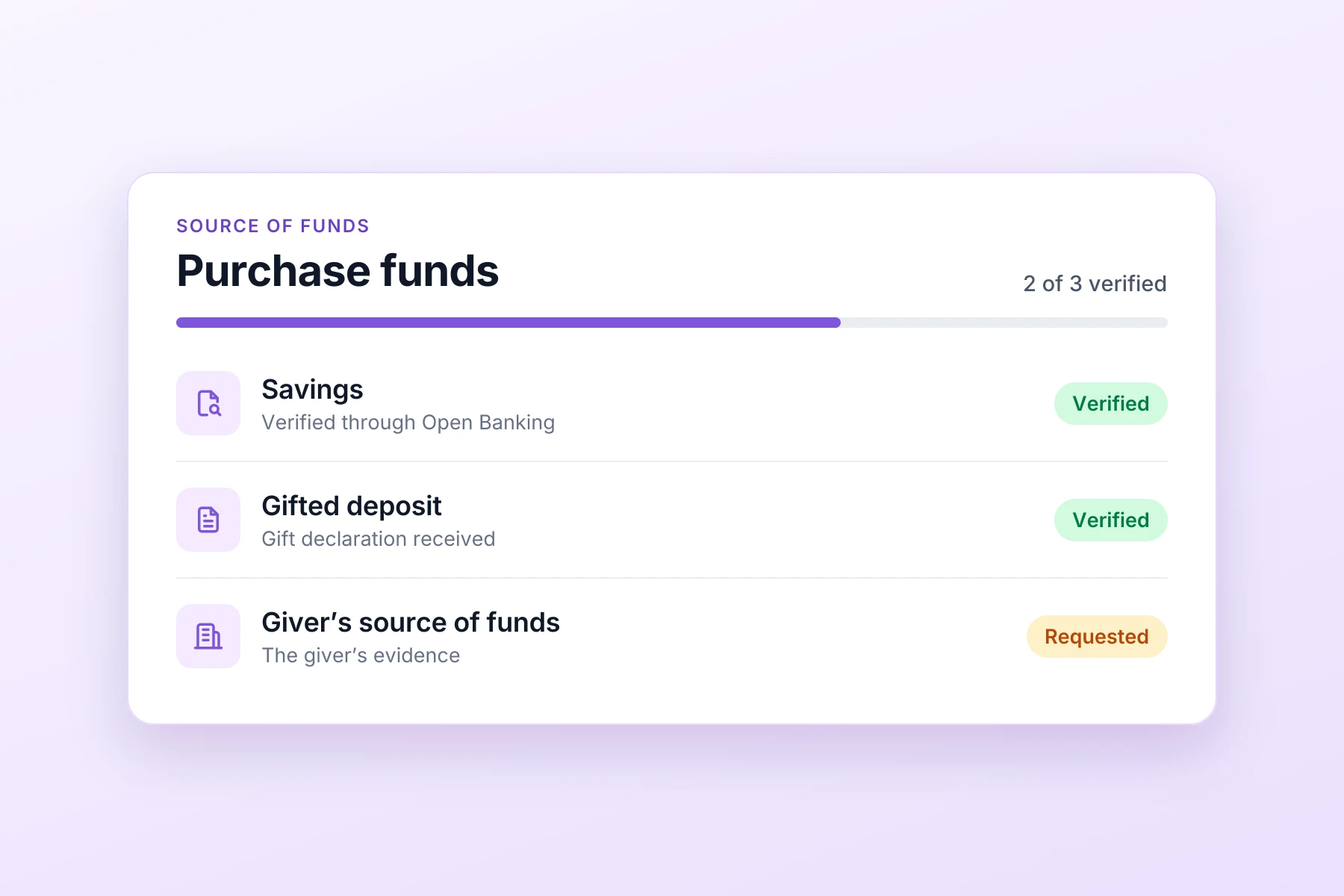
- Gifts: a signed gift declaration, confirming it is not a loan and that the giver will have no interest in the property, plus the giver's identity and evidence of where their money came from.
- Business funds or bonuses: accounts, payslips or confirmation from an accountant, proportionate to the amount.
Ask for it all at the start, with a checklist, so the client sends everything once.
Red flags
Look harder, and record why, when you see:
- Cash, or money paid in cash shortly before it reaches you.
- Money from third parties the client has not explained, or a buyer who wants to pay from several accounts.
- Funds from overseas, especially from higher-risk jurisdictions.
- Sudden large deposits that the client's income does not explain.
- Crypto assets converted to sterling, where the trail is harder to follow.
- A story that changes, or documents that do not match what the client has told you.
- Pressure to move quickly or to skip steps.
A red flag is a reason to ask questions, not necessarily to stop. If the answers do not satisfy you, take it to your money laundering reporting officer.
What to record on the file
Supervisors look for a clear trail. For each matter, record:
- The risk assessment, and the level of checks it called for.
- What you asked for and what you received, with dates.
- How each source was verified, and any gaps that were explained.
- Why you were satisfied, in a sentence or two, especially where the evidence was not straightforward.
Making it faster for the client
Source of funds checks slow a matter down when evidence arrives in pieces. Two things help:
- Open Banking. The client approves access in their own banking app, and you receive a verified report built from real transactions and balances, instead of chasing downloaded statements.
- A clear request at the start, with a checklist matched to the client's sources, sent with your client care letter.
For a guide you can send to buyers, see what proof of funds does a solicitor need?
How Casera can help
Casera provides AML, ID and Open Banking source of funds checks to conveyancers, ordered from the same case as your searches. Your client approves access in their banking app, you get a verified report, and every result is stored with a full audit trail. There is no sign-up fee, minimum spend or contract. See AML and source of funds checks.
Frequently asked questions
What is the difference between source of funds and source of wealth?
Source of funds is where the money for this transaction comes from, such as savings, a sale or a gift. Source of wealth is how the client accumulated their wealth overall, such as employment, a business or an inheritance. Higher-risk matters and politically exposed persons need both.
Which regulations require source of funds checks?
The Money Laundering, Terrorist Financing and Transfer of Funds (Information on the Payer) Regulations 2017. They require scrutiny of transactions, including source of funds where necessary, and enhanced due diligence, including source of wealth and funds, for higher-risk clients and politically exposed persons.
How far back should bank statements go?
The regulations do not set a period: it is a risk-based judgement in your firm's policy. Many firms ask for enough history to show how the deposit built up, and more where the risk is higher.
Do I need to check the source of a gifted deposit?
Yes. Treat the giver's money as part of the funds: obtain a gift declaration, the giver's identity, and evidence of where the giver's money came from.
Can Open Banking be used for source of funds?
Yes. The client approves access in their own banking app, and the firm receives a report built from real transactions and balances, rather than statements the client has downloaded.