
Missing Building Regulations Certificate? What Buyers Can Do
A missing building regs certificate or undischarged planning condition can stall a purchase. Where the documents are kept, and what to do if they cannot be found.
Key takeaways
- A local authority search shows what the council's records hold. It does not include copies of the certificates themselves.
- A building regulations certificate comes from whoever signed off the work: the council, a private building control approver or, for work such as replacement windows and boilers, a competent person scheme.
- On a new build, records are often filed under the development name or plot number rather than the postal address, which is a common reason they cannot be found.
- Evidence that planning conditions were discharged is on the council's planning register, under the original planning application.
- If a document cannot be found, the usual fixes are a regularisation certificate, a retrospective application or indemnity insurance. Speak to your solicitor before anyone contacts the council.
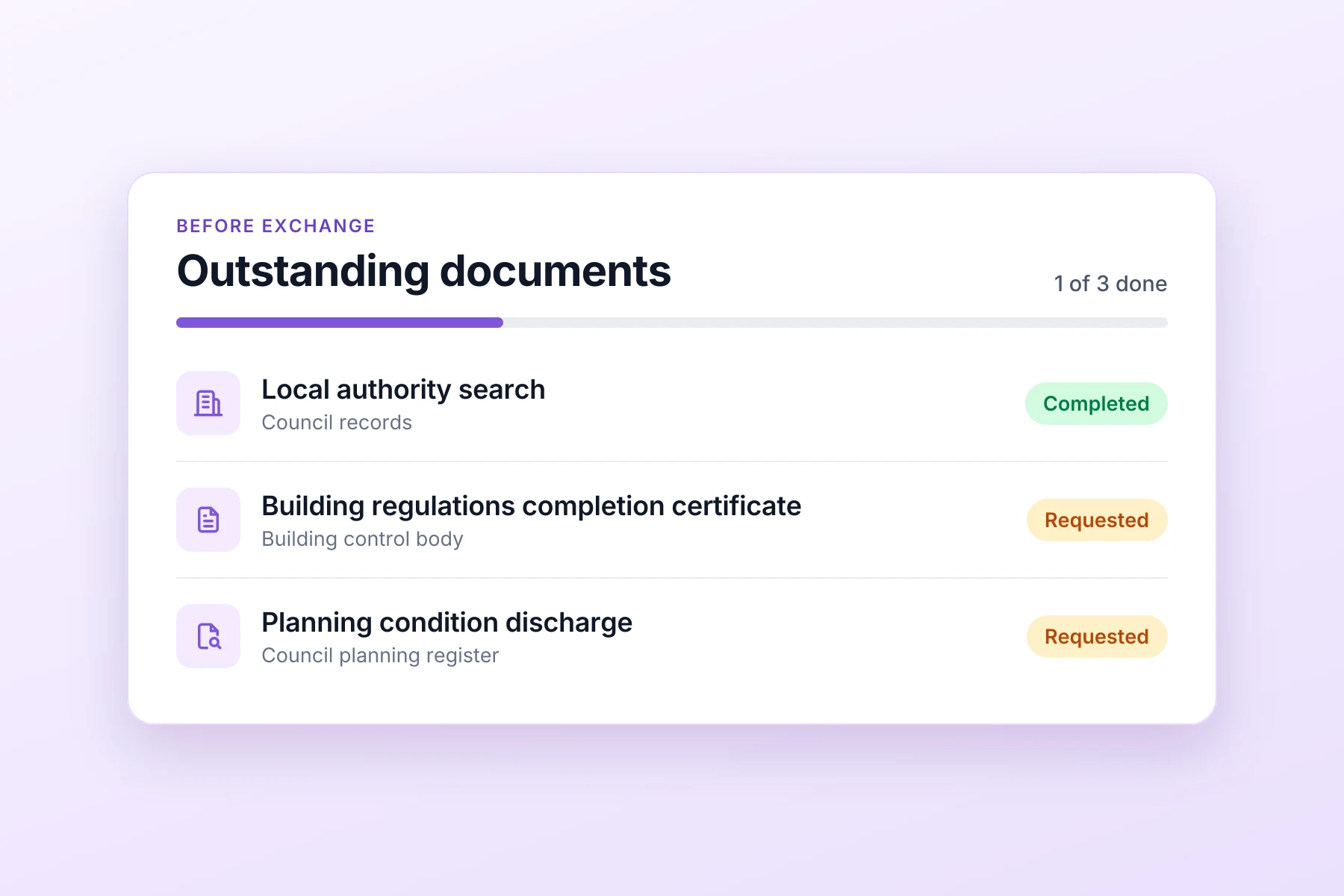
Your searches are back, your mortgage offer is in, and the purchase is still stuck on two pieces of paper: the building regulations completion certificate and proof that the planning conditions were discharged. Whether the certificate is missing, lost or was never passed on, it is one of the most common reasons a purchase stalls late on.
The documents usually exist somewhere. This guide explains where they are kept, how to get copies, and what your solicitor can do if they cannot be found. If your searches have not come back yet, start with why searches take so long.
Why your searches did not include the certificate
A local authority search reports what the council's records show about the property: its planning history, building regulations approvals and completion certificates, and any enforcement action. It tells you whether a document is on the council's records. It does not include a copy of it.
So a search can be complete and accurate, and your solicitor can still need the documents themselves. They ask the seller's solicitor first. When the seller does not have them, which is common when a house has changed hands or the paperwork never reached the first owner, someone has to get copies from the body that issued them.
Where a building regulations certificate comes from
Building work is signed off by a building control body, and the certificate comes from whichever one did the job:
- The council's building control team issues a completion certificate, and keeps a record of every one it has issued.
- A private building control approver, called an approved inspector before April 2024, issues a final certificate. The council receives a copy for its register, but the approver may be quicker to provide one.
- A competent person scheme covers work that installers can certify themselves, such as replacement windows, boilers and electrics. The certificate comes from the scheme, for example FENSA for windows or Gas Safe Register for boilers.
Your local search lists the building control records the council holds, so it usually shows which route the work went through and when it was signed off. That is where to start looking.
Building regulations completion certificate for a new build
A new build should come with a full set of paperwork, but it is also where documents most often go missing between the developer, its solicitor and the buyer.
- The certificate usually comes from a private approver. Many developers use the building control service of their new home warranty provider, or another private approver, rather than the council. The developer, or the approver named on the council's register, is the place to ask.
- Records are often filed under the development, not your address. Approvals and certificates are registered while the estate is being built, under its site name, plot numbers or planning reference, often before postal addresses exist. A request under the finished postal address can come back empty when the records are there under a different name.
- Your lender will want the warranty too. For a newly built home, most lenders need a new home warranty from a provider they accept, and they are often less willing to accept indemnity insurance in place of a missing certificate. A missing final certificate on a new build is usually fixed by getting the approver to issue it, not by insuring around it.
Planning conditions not discharged
Planning permission usually comes with conditions. They come in two kinds, and only one leaves paperwork behind.
- Conditions that need details approved. These say something must be agreed with the council before work starts or before anyone moves in, such as materials, drainage, landscaping or parking. The developer applies to discharge them, and the council issues a decision. That decision is the evidence your solicitor is looking for.
- Conditions that just have to be complied with. These say how the property must be built or used, such as in line with the approved plans, or with the garage kept for parking. There is nothing to discharge, so there is no certificate to find. Your solicitor may ask the seller to confirm the condition has been met instead.
Discharge decisions are published on the council's planning register, under the original planning application. On a new estate, the developer usually discharges the conditions for the whole site at once, so the decisions sit under the estate's planning reference rather than your plot.
How to get a copy of a building regulations certificate
Work through it in this order, and agree each step with your solicitor:
- Ask the seller's solicitor, or on a new build the developer's solicitor, for the certificate and the discharge decisions. They may be in the original purchase file.
- Check what the council's records say. Your local search shows which building control body signed the work off, and the planning register shows which conditions were discharged and when.
- Request a copy from the body that issued it: the council's building control team, the private approver, or the competent person scheme. There may be a fee, and response times vary.
- Request copies of the planning decisions from the council if they are not online, quoting the planning reference rather than the postal address on a new build.
If no one on the transaction has the time to find the right department and chase it, a document retrieval service can do it for them.
If the certificate cannot be found
Sometimes the document does not exist: the work was never signed off, or the conditions were never discharged. Your solicitor will advise on the right route, but these are the usual options.
- Regularisation certificate. The council's building control team can inspect work carried out without approval and, if it complies, certify it after the event. It is only available from the council, for work carried out after 11 November 1985, and may involve opening up walls or floors for inspection, or making changes before it is signed off.
- Building regs indemnity insurance. A one-off policy that covers your financial loss if the council takes enforcement action over the work. It does not mean the work is safe or compliant, and your lender has to accept it.
- A retrospective application to discharge a planning condition, so the council approves the details after the event.
- Planning indemnity insurance for a breach of a planning condition, where the lender accepts it.
Do not contact the council about the missing document yourself before your solicitor has advised. Most indemnity policies cannot be used once the council has been told about the problem, so an early phone call can rule out the quickest fix. Let your solicitor decide who contacts the council, and when.
How Casera can help
Casera works with solicitors and conveyancers on the searches and documents a purchase needs. When a document is holding things up, our own search team can:
- Find and request the document from the council, the building control approver or another body, and chase it until it arrives. See document retrieval.
- Arrange indemnity insurance from Stewart Title, on the same case as the searches, where your solicitor decides a policy is the right route. See legal indemnity insurance.
We work through your solicitor, not around them. If your purchase is held up, tell us what is missing and who your solicitor is, and we will take it from there.
Frequently asked questions
Can I get a copy of a building regulations certificate?
Usually, yes. Ask the seller's solicitor first. If they do not have it, the body that signed off the work can provide a copy: the council's building control team, the private building control approver, or the competent person scheme for work such as windows and boilers. There may be a fee.
Can I buy a house without a building regulations completion certificate?
You can, but your lender may not lend until the problem is resolved, and you take on the risk of the council enforcing against work that does not comply. The usual options are a regularisation certificate or building regulations indemnity insurance, if your lender accepts it. Your solicitor will advise which fits your purchase.
What happens if planning conditions are not discharged?
The council could take enforcement action over the breach, and your lender may not lend until it is resolved. The usual options are a retrospective application to discharge the condition, or indemnity insurance where the lender accepts it.
Do all planning conditions need to be discharged?
No. Only conditions that need details approved by the council, such as materials, drainage or landscaping, are discharged by a council decision. Others, such as building in line with the approved plans, simply have to be complied with, so there is no discharge paperwork to find.
What does building regs indemnity insurance cover?
It covers your financial loss if the council takes enforcement action over work that lacked building regulations sign-off, such as the cost of putting it right. It does not mean the work is safe or compliant, and most policies cannot be used once the council has been told about the problem.