AML Checks for Estate Agents: What HMRC Expects
Estate agents must run AML checks on buyers as well as sellers. Who has to comply, when each check is due, what to keep on file and what affects the cost.
Key takeaways
- Estate agency businesses are supervised by HMRC under the Money Laundering Regulations 2017, and must apply to register before they trade.
- The buyer is your customer as well as the seller: both need customer due diligence.
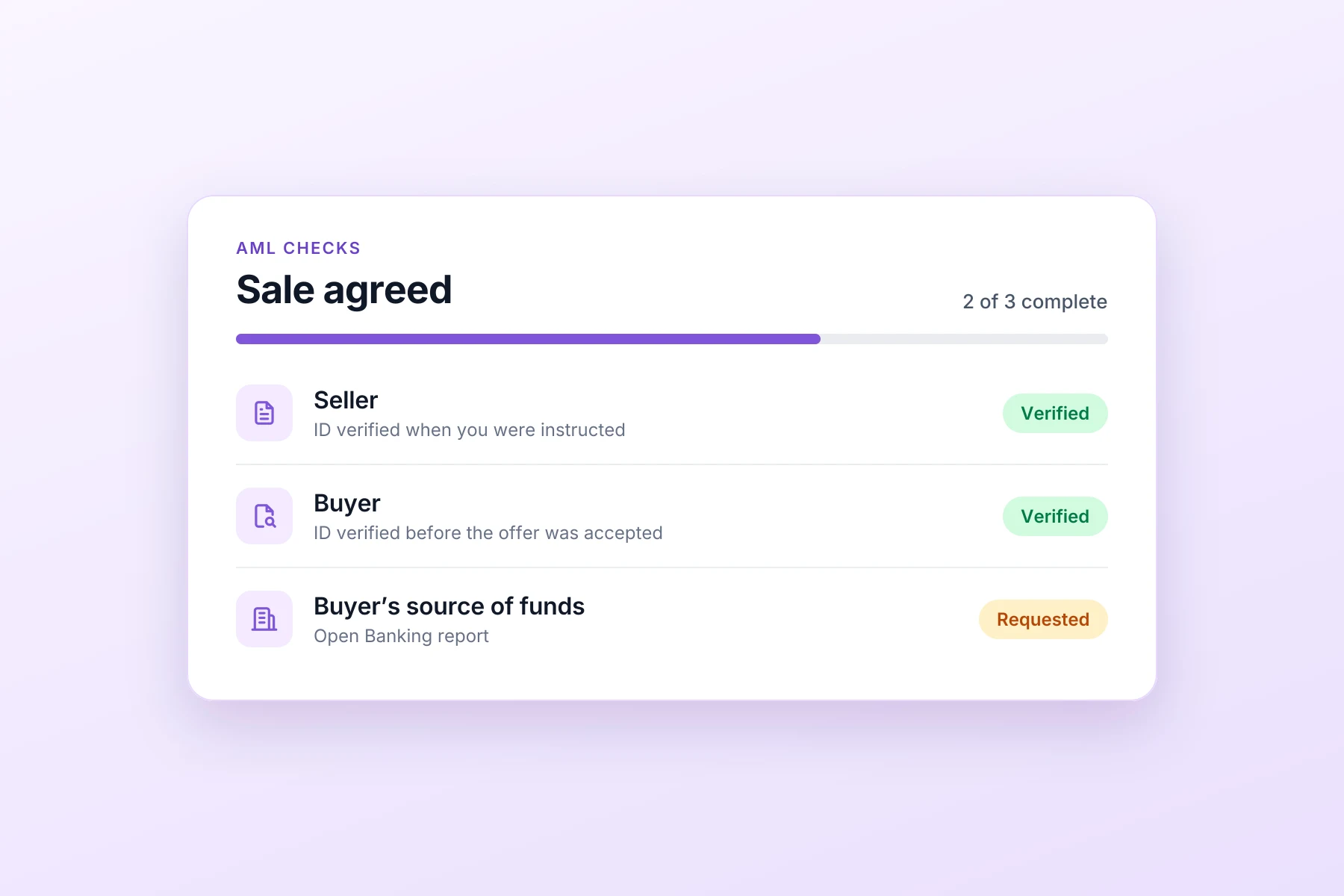
- Check the seller by the time they instruct you. Checks on the buyer must be complete before a binding contract, and HMRC recommends finishing them before the offer is accepted.
- Due diligence means identifying the customer, verifying their identity, finding any beneficial owners and understanding the transaction. Higher-risk customers need enhanced checks, including verified source of funds.
- Keep the evidence for five years after the relationship ends, with a note of why you were satisfied.
- What checks cost depends on how you buy them: a contract with a provider usually brings a sign-up fee and a minimum spend, and pay-as-you-go checks do not.
Estate agents have to carry out anti-money laundering (AML) checks on every sale, on the buyer as well as the seller. HMRC supervises estate agency businesses under the Money Laundering Regulations 2017, and it expects the checks to be done at the right time, matched to the risk, and recorded.
This guide sets out who has to comply, who and what you have to check, when each check must be done, what to keep on file, and what affects the cost.
Do estate agents need to do AML checks?
Yes. Estate agency work is regulated under the Money Laundering Regulations 2017, and HMRC is the supervisor. HMRC's guidance for estate agency businesses, published in July 2026, says a business must not trade as an estate agency business until it has applied to register.
The definition is wide. It covers dealing with people who want to buy or sell property, including arranging viewings and advising sellers or buyers. A business that only gives buyers and sellers a way to contact each other directly is outside it.
Letting is treated differently: letting agency businesses need to register only where they let property or land at a rent equivalent to 10,000 euros or more a month.
Who you have to check: the seller and the buyer
The seller is your customer, and so is the buyer, even though the buyer pays you nothing. Regulation 4 says an estate agent "is to be treated as entering into a business relationship with a purchaser (as well as with a seller), at the point when the purchaser's offer is accepted by the seller".
So every sale needs checks on both sides:
- Each individual selling or buying.
- The people behind a company or trust. Where the customer is not an individual, identify its beneficial owners and take reasonable measures to verify who they are.
- Your own seller in a shared instruction. In a joint sole agency, each agent is responsible for its own due diligence on the seller.
What the checks involve
Customer due diligence has four parts:
- Identify the customer and verify their identity from a reliable source, such as an identity document.
- Identify any beneficial owners, and take reasonable measures to verify them.
- Understand the transaction: who is buying or selling, why, and how the purchase is being paid for.
- Keep watching until the sale completes. HMRC's guidance gives examples of what to look for: a source of funds that changes during the transaction, a gifted deposit, or a last-minute change of mortgage provider.
Some customers need more. Enhanced due diligence applies where the risk is higher, including politically exposed persons (PEPs), and it requires you to verify the customer's source of funds and source of wealth. HMRC adds that you may decide to verify source of funds on other sales if your risk assessment calls for it, and that cash buyers warrant extra care. You must not deal with anyone on the UK sanctions list, which is why checks screen for sanctions as well as PEPs.
If you cannot complete the checks, you must not go ahead: end the relationship and consider whether to make a suspicious activity report.
When each check must be done
- The seller: as soon as possible after first contact, and by the time the business relationship is established, which is when they agree to instruct you.
- The buyer: the checks must be complete before a binding contract is entered into, which is usually exchange of contracts. HMRC recommends completing them as soon as possible after first contact, and before the offer is accepted. In practice, start when the terms are agreed.
- At auction: HMRC suggests pre-registering bidders, so the checks are done before the hammer falls.
Leaving the buyer until the week of exchange is where sales get held up. A buyer who is asked on the day their offer is accepted can finish an ID check on their phone the same day.
What to keep on file
HMRC looks at the business as well as the individual sale. The regulations require:
- A written risk assessment of your business, kept up to date.
- Written policies, controls and procedures that follow from it.
- A nominated officer, who receives reports of suspicion from staff and decides whether to report to the National Crime Agency.
- Training, so that staff know the rules and can recognise a suspicious transaction.
- Records. Under regulation 40, keep copies of the documents and information obtained for customer due diligence, and supporting records of the transaction, for five years from the end of the business relationship.
For each sale, record what you asked for, what you received and why you were satisfied. HMRC can penalise a business that does not comply, including one that trades without registering, and it publishes the penalties it issues.
What affects the cost of AML checks
What you pay depends less on the price of a single check than on how you buy them. Signing up with an AML provider directly usually means a fee up front, a minimum annual spend and a contract. That can suit an agency with steady volume, and less so one that agrees a handful of sales a month.
Pay-as-you-go checks have none of those. Ordered through Casera:
- You pay a price per check, quoted for your agency.
- There is no sign-up fee, minimum spend or contract.
- You can order a one-off check, or as many as a busy month needs.
A Safe Harbour check reads the chip in your customer's passport and matches their face to it, on their own phone, and screens them for PEPs and sanctions. It is the check conveyancers use to meet HM Land Registry's digital ID standard. The source of funds check uses Open Banking: the buyer approves access in their banking app, and you receive a report built from their transactions and balances.
Whether you absorb the cost or pass it on is your decision: the regulations do not say who pays. If you charge a fee, tell the customer the amount before they are committed to paying it.
How Casera can help
Casera provides pay-as-you-go AML and ID checks and Open Banking source of funds to estate agents, ordered from your agency's own account. Sellers and buyers complete the check on their phone, and every result is time-stamped and stored, ready if HMRC asks for it. See AML checks for estate agents.
The same account orders property searches for estate agents, for agencies preparing for upfront searches and sales packs. For a guide you can send to buyers who ask why they are being checked, see what proof of funds does a solicitor need?
Frequently asked questions
Do estate agents need to do AML checks?
Yes. Estate agency businesses are regulated under the Money Laundering Regulations 2017 and supervised by HMRC. They must carry out customer due diligence on their customers, which means the buyer as well as the seller.
Do estate agents have to check the buyer as well as the seller?
Yes. Under regulation 4 of the Money Laundering Regulations 2017, an estate agent is treated as entering into a business relationship with the purchaser, as well as with the seller, when the purchaser's offer is accepted.
When do the buyer's AML checks have to be done?
They must be complete before a binding contract is entered into, which is usually exchange of contracts. HMRC recommends completing them as soon as possible after first contact, and before the offer is accepted.
How much do AML checks cost for estate agents?
It depends on how you buy them. Signing up with a provider directly usually means a fee up front, a minimum annual spend and a contract. Pay-as-you-go checks have none of those: through Casera you pay a price per check, quoted for your agency, for the checks you order.
Can estate agents charge for AML checks?
The regulations make the checks the agent's responsibility and do not say who pays for them. Some agents absorb the cost and others charge a fee. If you charge one, tell the customer the amount before they are committed to paying it.
How long do estate agents have to keep AML records?
Five years from the end of the business relationship. That covers copies of the documents and information obtained for customer due diligence, and supporting records of the transaction.
Do letting agents need to do AML checks?
Letting agency businesses are supervised by HMRC only where they let property or land at a rent equivalent to 10,000 euros or more a month.