
Material Information Checklist for Property Listings
A free, downloadable material information checklist for estate agents. Every Part A, B and C item, where its answer usually comes from, and which ones the searches cover.
Key takeaways
- The checklist covers every item in the withdrawn Parts A, B and C, which are still the clearest guide to what a listing needs.
- Parts A and B apply to every listing. Part C applies where relevant, and is where most gaps appear.
- For each item it shows where the answer usually comes from: the seller, the title, an official checker or a property search.
- Searches answer several Part C questions, such as planning, flood risk and mining, so ordering them at listing fills the hardest gaps first.
- It is a guide, not legal advice: the duty is to include whatever the average buyer needs to know.
Every listing has to give buyers the information they need to make an informed decision. The rule is simple to state and easy to fall short of, especially on the Part C questions a seller often cannot answer.
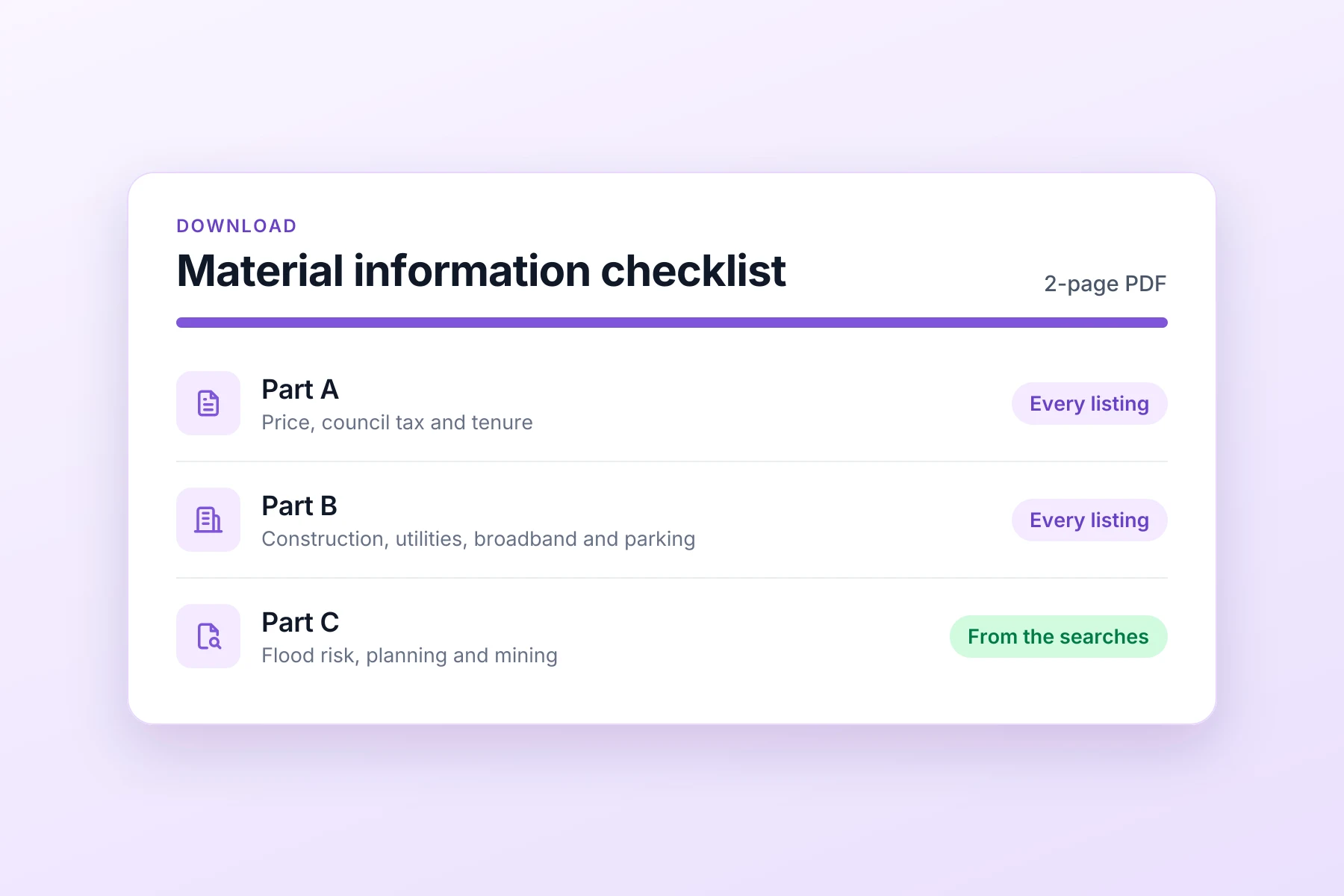
This checklist turns the withdrawn Parts A, B and C into a two-page PDF you can work through for each listing, with where each answer usually comes from. For the law behind it, see material information for estate agents.
What the checklist covers
- Part A, every listing: the price, the council tax band and the tenure, with the lease, ground rent and service charge for a leasehold, and the share and rent for shared ownership.
- Part B, every listing: construction, rooms and floor area, electricity, water, sewerage and heating, broadband, mobile signal and parking.
- Part C, where it applies: building safety, listed status, conservation areas and tree preservation orders, covenants and rights of way, flood and erosion risk, planning, accessibility, and coalfield or mining areas.
Where the answers come from
Most of the work is knowing who to ask. The checklist shows a source for every item:
- The seller: the supplies, heating, parking, adaptations and anything they know about the property's history.
- The title register and the seller's conveyancer: the tenure, covenants, rights of way and easements.
- Official checkers: the council tax band on GOV.UK, and broadband and mobile coverage from Ofcom.
- The EPC and floor plan: construction, rooms and floor area.
- The managing agent or landlord: lease details, service charges and building safety for a leasehold.
- The property searches: planning, listed status, conservation areas, tree preservation orders and public rights of way from the local authority search; flood and erosion risk from the environmental search; water and sewerage from the drainage and water search; and coal mining from a mining search.
Why the searches matter most
Part C is where most gaps appear, because the seller often does not know about a planning application next door or the property's flood risk. Those are exactly the questions the searches answer.
Order the searches when the seller instructs you, and the hardest items on the checklist are answered before the listing goes live. Pass the results to the seller's conveyancer, and leave their interpretation to the conveyancers. See upfront searches and sales packs.
How to use it for each listing
- Fill in the property and seller at the top of the first page.
- Work through Parts A and B with the seller at the valuation or instruction.
- Order the searches for the items marked Search, and complete Part C when they are back.
- Add anything else a buyer would need to know. The checklist is a minimum, not a limit.
- Keep it on file with the listing, as a record of what you checked and where the answers came from.
How Casera helps estate agents
Casera provides property searches to conveyancers, and to estate agents who order them when a property is listed. Your agency orders the searches from its own account and recharges the seller. Our local authority searches are regulated searches, and their Stewart Title indemnity covers the buyer and their lender, whoever ordered them. If the sale takes longer than six months, we refresh them free of charge.
Frequently asked questions
Is there an official material information checklist?
Not at the moment. National Trading Standards withdrew its Parts A, B and C guidance in May 2025, and the government's new guidance and standardised form had not been published as of November 2026. Parts A, B and C remain the clearest checklist.
What is in Part A of material information?
The price, the council tax band and the tenure, plus for a leasehold the length of the lease, the ground rent and the service charge, and for shared ownership the share, rent and service charge.
What is in Parts B and C?
Part B covers the property itself: construction, rooms, utilities, heating, broadband, mobile signal and parking. Part C covers what applies to some properties: building safety, restrictions and rights, flood and erosion risk, planning, accessibility, and coalfield or mining areas.
Is the checklist free?
Yes. Enter your name, agency and work email, and the PDF downloads straight away.