Material Information for Estate Agents: The Rules in 2026
Trading Standards withdrew its Parts A, B and C guidance in 2025, but the duty to give material information remains. What estate agents must include now, and what is coming.
Key takeaways
- Estate agents must not leave out material information from a listing: the information the average buyer needs to make an informed decision.
- The duty is in the Digital Markets, Competition and Consumers Act 2024, in force since 6 April 2025, which replaced the regulations the old guidance was based on.
- National Trading Standards withdrew its Parts A, B and C guidance on 8 May 2025. The duty did not go away, and the three parts are still a sensible checklist.
- The Competition and Markets Authority can now fine agents directly, up to £300,000 or 10% of global turnover, whichever is higher.
- The government plans listing guidance and a code of practice for agents, and later a sales pack, including searches, prepared before a property is listed.
Every listing has to give buyers the information they need to decide whether to view, offer and buy. Since 2025, the law behind that duty has changed, the guidance most agents worked from has been withdrawn, and the government has set out plans for a sales pack prepared before a property goes on the market.
This guide explains what the law requires of estate agents now, what a listing should cover, who enforces it, and what is coming next.
What material information means
Material information is the information the average buyer needs to make an informed decision about a property: whether to view it, make an offer or go ahead with the purchase. Leaving it out, hiding it or presenting it unclearly is a misleading omission.
The test is about the buyer, not the seller. If you know something about the property that a buyer would need to know, it belongs in the listing, whether or not the seller has raised it.
The law since April 2025
Since 6 April 2025, the duty has been in Part 4 of the Digital Markets, Competition and Consumers Act 2024, which replaced the Consumer Protection from Unfair Trading Regulations 2008. The test is the same as before: a listing must not leave out information the average consumer needs to make an informed decision. What changed is how it is enforced.
What happened to Parts A, B and C
The National Trading Standards Estate and Letting Agency Team published its material information guidance in three parts in 2022 and 2023. Because it was written for the 2008 regulations, it was withdrawn on 8 May 2025, when those regulations were replaced. The duty to give material information did not change.
The property portals still ask for much the same details, and the three parts remain a sensible checklist of what a listing should cover.
A material information checklist
Use the old parts as a checklist for every listing:
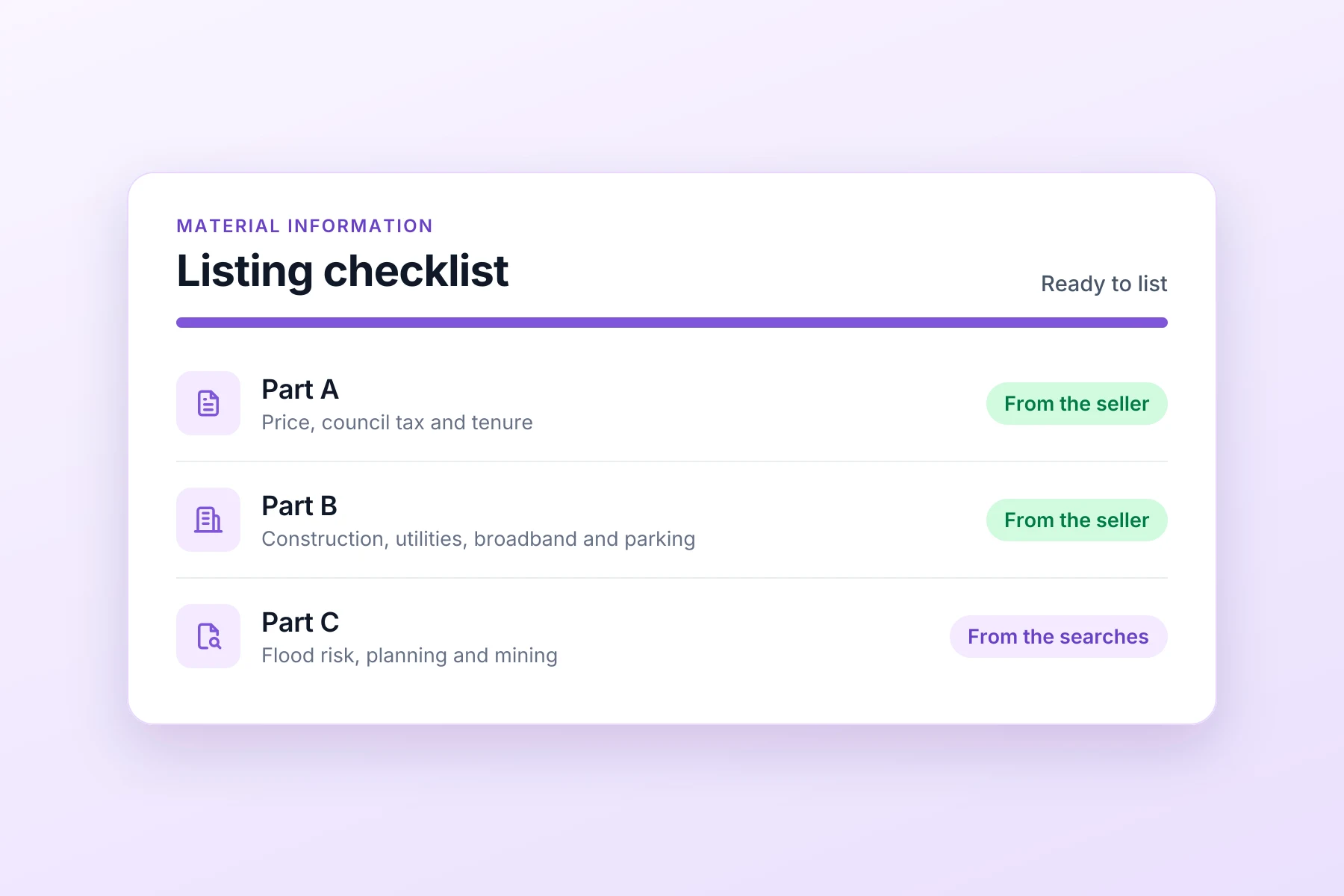
- Part A, for every property: the price, the council tax band and the tenure. For a leasehold, the ground rent, the service charge and the length of the lease.
- Part B, for every property: the type of property and how it is built, the number and type of rooms, the electricity, water, sewerage and heating, broadband and mobile signal, and parking.
- Part C, where it applies: building safety issues, rights and restrictions such as covenants, rights of way or listed status, flood and erosion risk, planning permissions and proposals nearby, accessibility and adaptations, and whether the property is in a coalfield or mining area.
Part C is where most gaps appear, because the seller often does not know the answers. Several of them, such as flood risk, planning history and mining, are what property searches report on.
For a version you can work through for each listing, with where each answer comes from, download our material information checklist.
Who enforces it, and the penalties
Trading Standards, including the National Trading Standards Estate and Letting Agency Team, still enforce the rules. Under the 2024 Act, the Competition and Markets Authority can also investigate and fine agents directly, without going to court, up to £300,000 or 10% of global turnover, whichever is higher. Some breaches are also criminal offences.
What is changing: sales packs and new guidance
In June 2026, the government published its home buying and selling reform roadmap, its response to the 2025 consultations on home buying and selling and on material information in property listings. For agents, it sets out three things:
- Guidance on listings and a code of practice. Non-statutory guidance on the information property listings should include, and a code of practice with minimum standards for property agents.
- Sales pack information sellers can provide now. The government will work with the industry on the information that can be provided upfront voluntarily.
- A sales pack before listing. Legislation, when parliamentary time allows, to require a sales pack before a property is listed, including searches and a property condition report. The seller stays responsible for the pack.
As of November 2026, none of this is law, and the guidance and code have not been published. For how agents can order searches before listing now, see upfront searches and sales packs.
Where property searches fit
Searches answer many of the Part C questions. A local authority search covers planning and building control history, roads and local land charges, an environmental search covers flood risk and ground stability, and a mining search covers coal mining. The roadmap includes searches in the future sales pack.
Ordering searches when the seller instructs you, rather than after an offer, puts those answers in front of you before the listing goes live. Two cautions:
- A search result can be material information. If it shows something a buyer would need to know, pass it to the seller's conveyancer and agree with the seller how it is described in the listing.
- Leave the interpretation to the conveyancers. Report what the search says, and do not advise buyers on what it means for them.
How Casera helps estate agents
Casera provides property searches to conveyancers, and to estate agents who want them in place before a property is listed. Your agency opens its own account, orders the local authority, drainage and water, and environmental searches, and recharges the seller. Our local authority searches are regulated searches, and their Stewart Title indemnity covers the buyer and their lender, whoever ordered them. If the sale takes longer than six months, we refresh the searches free of charge.
Frequently asked questions
Is the material information guidance still in force?
No. National Trading Standards withdrew Parts A, B and C on 8 May 2025, when the regulations they were based on were replaced. The legal duty not to leave out material information remains, now under the Digital Markets, Competition and Consumers Act 2024.
What counts as material information?
Information the average buyer needs to make an informed decision about a property: whether to view it, make an offer or go ahead. The withdrawn Parts A, B and C are still a good guide to what that covers.
Who enforces material information rules?
Trading Standards, including the National Trading Standards Estate and Letting Agency Team, and since April 2025 the Competition and Markets Authority, which can investigate and fine agents directly.
Do estate agents have to provide property searches?
Not yet. The government's June 2026 roadmap plans to require a sales pack, including searches, before a property is listed, once legislation is passed. Until then it is voluntary.
Should search results go in a listing?
If a search shows something the average buyer would need to know, such as a flood risk or a planning issue, it may be material information. Pass the results to the seller's conveyancer and agree with the seller how it is described.